
As a CIPR Chartered PR professional, I always look to understand and follow industry best practice and, when it comes to the measurement and evaluation of communications, there is no better reference point than AMEC’s ‘Barcelona Principles’.
The Barcelona Principles were first launched in 2010 to tackle the challenge of communications professionals being without a common approach to measuring the effectiveness of their work - which hampered the credibility, trust and understanding of the industry and those that worked within it.
I think the principles have strengthened the growing recognition that communications should be considered a strategic management discipline that should contribute to organisational decision-making. Excellent strategic PR can protect and enhance reputations and change behaviours, and good measurement proves and improves it.
The Barcelona Principles, which are updated every five years, are designed to provide a ‘helicopter view’ of seven best practice principles. Over time, they have become more nuanced.
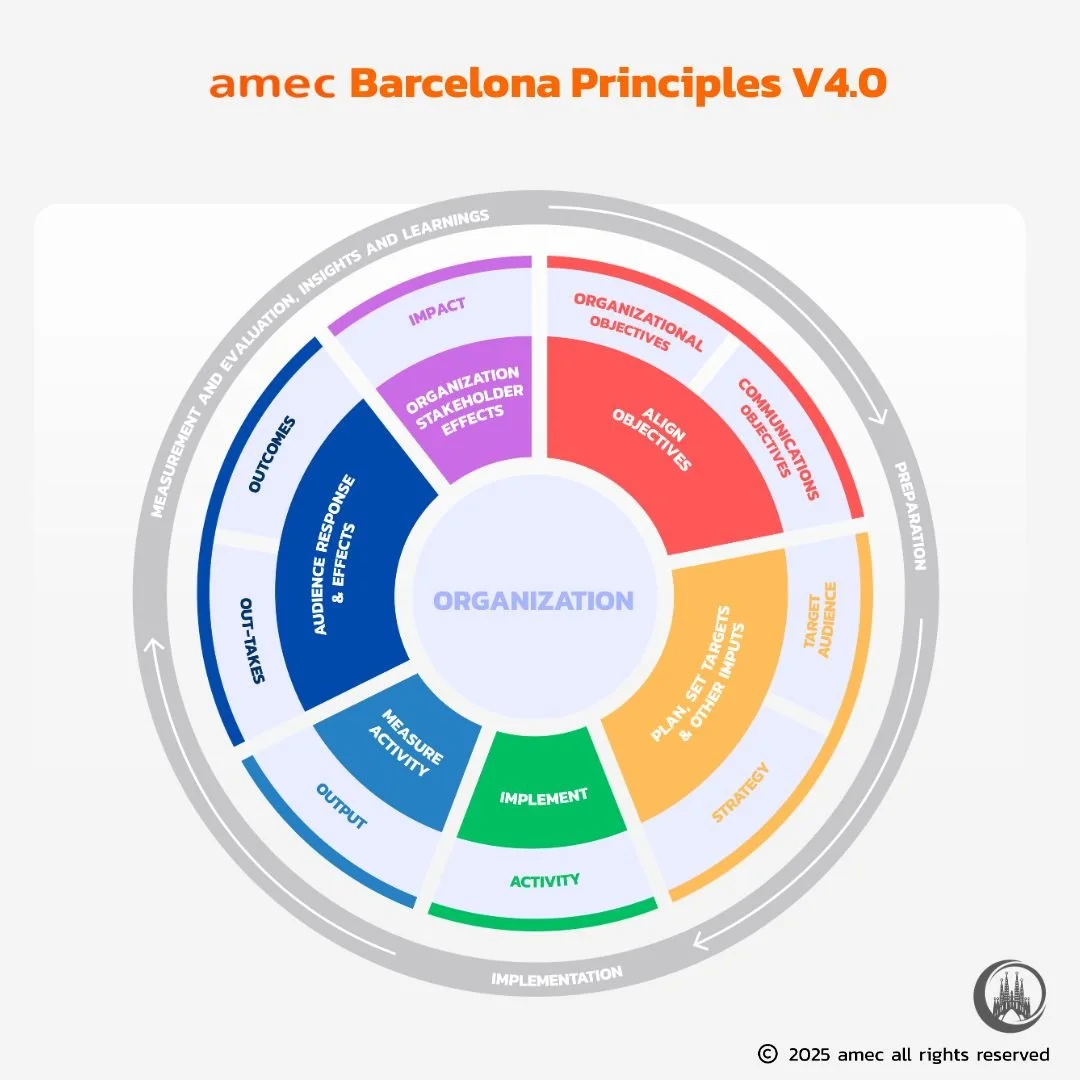
I have followed the principles since they were first published and they are embedded within our own MERTO Map planning framework, so, when the latest iteration - the Barcelona Principles V4.0 - was published in July, I was eager to see what has changed.
‘Subtle but important shifts’
The Barcelona Principles V4.0 e-book lists a handful of shifts that it defines as subtle but important, and these were emphasised in the excellent AMEC Barcelona Principles 4 0 Launch Webinar, in which a representative of each of the seven panels described how they had approach improving the principle their group was responsible for.
Interesting elements included:
Outputs and outcomes - the need to focus the journey from outputs (articles, events, content) to outcomes (changes in perception or behaviour), rather than focusing on just one of them in isolation. This has always been a big focus of our MERTO Map planning method, which is designed to understand audiences and then create campaigns that reach them and take them on a journey to action that, ultimately, leads to an outcome.
Audiences as co-creators - too much communications activity sees reaching audiences as the end goal, whereas a good evidence-based strategy should identify audiences as co-creators of value. Our MERTO Map planning tool starts by identifying priority audiences and then understanding their barriers and drivers, so that messages and channels are designed with them in mind, and influential enabler audiences like journalists, politicians, health professionals and Key Opinion Leaders are part of our audience engagement strategy. This aligns with V4.0.
Terminology of ‘Stakeholder audiences’ - which bridges together academia (which prefers the term ‘stakeholder’) and industry (which prefers the term ‘audiences’). I like this! Academics dislike audiences because it implies one way broadcast communications, and marrying the two together works well.
Ongoing use - the need for interactive and ongoing measurement for long-term success and improvement. Those clients and campaigns that you get the opportunity to support long-term can enable this kind of iterative improvement over time, which we demonstrated with our veterans campaign work for the Royal College of GPs, which recently won the UK’s Best Long-Term Campaign at the CIPR Excellence Awards because we were able to increase its impact every year for four years.
Ethics and governance - in this changing landscape, particularly with the rapid rise of AI, it is clear that transparency and rigour become increasingly important.
The 7 Principles in full
The newly updated principles are below. The bolded text is the official wording and, below each, I provided a brief summary of the key points:
Setting clear measurable objectives is a critical prerequisite for effective communication planning, measurement and evaluation
The heartbeat of effectiveness, you must start with the outcome in mind. Best practice is to set SMARTER targets before starting, benchmark where possible and adjust as you learn.Defining and understanding all stakeholder audiences are essential steps to plan, build relationships and create lasting impact.
Outcomes are dependent on audience action, so we need to understand our stakeholder audiences in their broadest possible sources. Listen to what audiences care about, understand context such as social, political, economic, technological, cultural and sector, and be aware of the ways that different audiences consume or are influenced by information. Use multiple data sources and don’t rely on AI only (this point is very important!).Comprehensive communication measurement and evaluation should be applied to all relevant channels used to understand and influence audience stakeholders.
Prioritisation of channels should be guided by your objectives and the stakeholder audiences you must influence to achieve it. Think about where they go for information and what they trust. The e-book flags a range of channels including traditional media, social channels (with Reddit and TikTok flagged), newsletters and aggregators like Substack, websites, search data, AI search engine outputs, internal comms channels, podcasts, influencers, email and events, all of which can be included in your channel mix if they are used and trusted by your priority audience/s.Effective measurement and evaluation of communication require qualitative and quantitative analysis
There is more quantitative data available than ever before, which can be very positive. However, in this era of growing automation, we need to ensure that qualitative insights - explanations, context and interpretations - sit alongside it, in order for the data to be meaningful. Expert communicators are so important here as they can explain not only what happened (data on reach, backlinks, open rates, sign-ups, sales), but also why it happened (external events, comparison with past performance, emerging trends and habits) and what can be learned for the future.Invalid measures such as advertising value equivalents (AVEs) should not be used. Instead measure and evaluate the contribution of communication by its outcome and impact
This principle has shifted from focusing only on the need to eradicate AVEs to being more positive in providing practitioners with practical steps for how to approach this. Evergreen PR has never measured AVEs so this one is not relevant to us.Measurement and Evaluation should report outputs, outcomes, and impact related to the organization and stakeholder audiences
The webinar described how the AMEC Integrated Planning Framework is based on a programme logic model, which aligns it with other corporate planning models. The principle outlines the need to measure outputs, outtakes, outcomes and impact ‘holistically’ to understand the impact of the activity on both the organisation and its stakeholders. Ideally you should be able to map the outputs (the “tangible products of your communication, such as materials produced, content generated or events held”) to the outcomes (“the changes in attitude or behaviour that follow”). The impact is longer-term, and relates to broader social or organisational shifts.Ethics, governance, and transparency with data, methodologies and technology builds trust and drives learning
This was a very interesting one, particularly in light of the changing landscape and increasing use of AI. The webinar presenter mentioned a discussion among his panel where it was proposed that being able to trust data in the AI era is set to become one of society’s great challenges. I think this is absolutely right. With this in mind, being clear about where data came from, how analysis was done and evaluation methodologies will all become more important, too. Good governance will become increasingly vital as will professional standards and integrity, and, as was stated in the webinar, “communications professionals must resist the pressure to present only the good results.”
I have long been a fan of AMEC and the Barcelona Principles. In fact, I have written about them several times, for example in my practical guide to measuring business and health outcomes and the approach is baked into the MERTO Map planning process I developed.
AMEC 4.0 achieves the tall order of improving on an already excellent set of principles, fine tuning details while also responding to changes in the external landscape which make the job of measurement and evaluation more complex, but also more important.
About the author:

Leigh Greenwood is the founder and managing director of Evergreen PR, the healthcare PR agency that makes health happen. He is a chartered PR professional who has been working in healthcare PR, public affairs and communications for the last 20 years. He has worked across the whole spectrum of healthcare and has won more than 40 industry awards for effective health campaigns that generated measurable outcomes.
Find out more about Evergreen PR: about us, our services, our work.