
It’s rare for sleep to top anyone’s political priority list. But imagine taking an overlooked issue, dismissed by many as trivial, and not only making the Government acknowledge its seriousness but commit publicly to taking action. That’s exactly what we managed to achieve with our campaign for The Sleep Charity, ‘Dreaming of Change: A Manifesto for Sleep’ - recently crowned Healthcare and Pharma Campaign of the Year at the prestigious PRmoment Awards 2025.
This wasn’t just another awareness campaign. It directly prompted Government Ministers to promise action on sleep, and generated extensive top-tier media coverage from BBC Breakfast, ITV News, the Daily Mail, and even The Lancet, the world’s most influential medical journal.
Here’s how we did it:
Step 1: Finding the ‘Most Effective Route To Outcome’ (MERTO)
There were countless directions we could have taken, but we firmly believe that activity without meaningful outcomes is wasted effort. Using our proprietary MERTO (Most Effective Route to Outcomes) Map planning methodology – which incorporates best practice principles in behaviour science, prioritisation and measurement - we pinpointed exactly which actions would genuinely move the dial.
We knew we needed to:
Make the issue of insomnia impossible for the Government to ignore and create an inspiring vision of the future.
Capture the attention of the media and politicians with powerful new research spotlighting sleep issues.
Bring this to life by shining a light on powerful human stories.
Identify and engage those cross-party MPs who had expressed concern or interest in sleep problems.
Step 2: Powerful data that made sleep impossible to ignore
Sleep is frequently trivialised and not seen as a critical health issue – we’ve all heard the phrase, ‘sleep is for the weak’. We needed data that was truly impossible to ignore.
Having already gathered extensive information and secondary data in our research phase, we focused on uncovering that ‘something new’ through a rigorous public survey. However, obtaining impactful data isn’t as simple as asking a few questions - you need to ask the right ones and there’s a real skill to that. Thankfully, we’re experienced in designing surveys specifically to create powerful data points and strong news hooks.
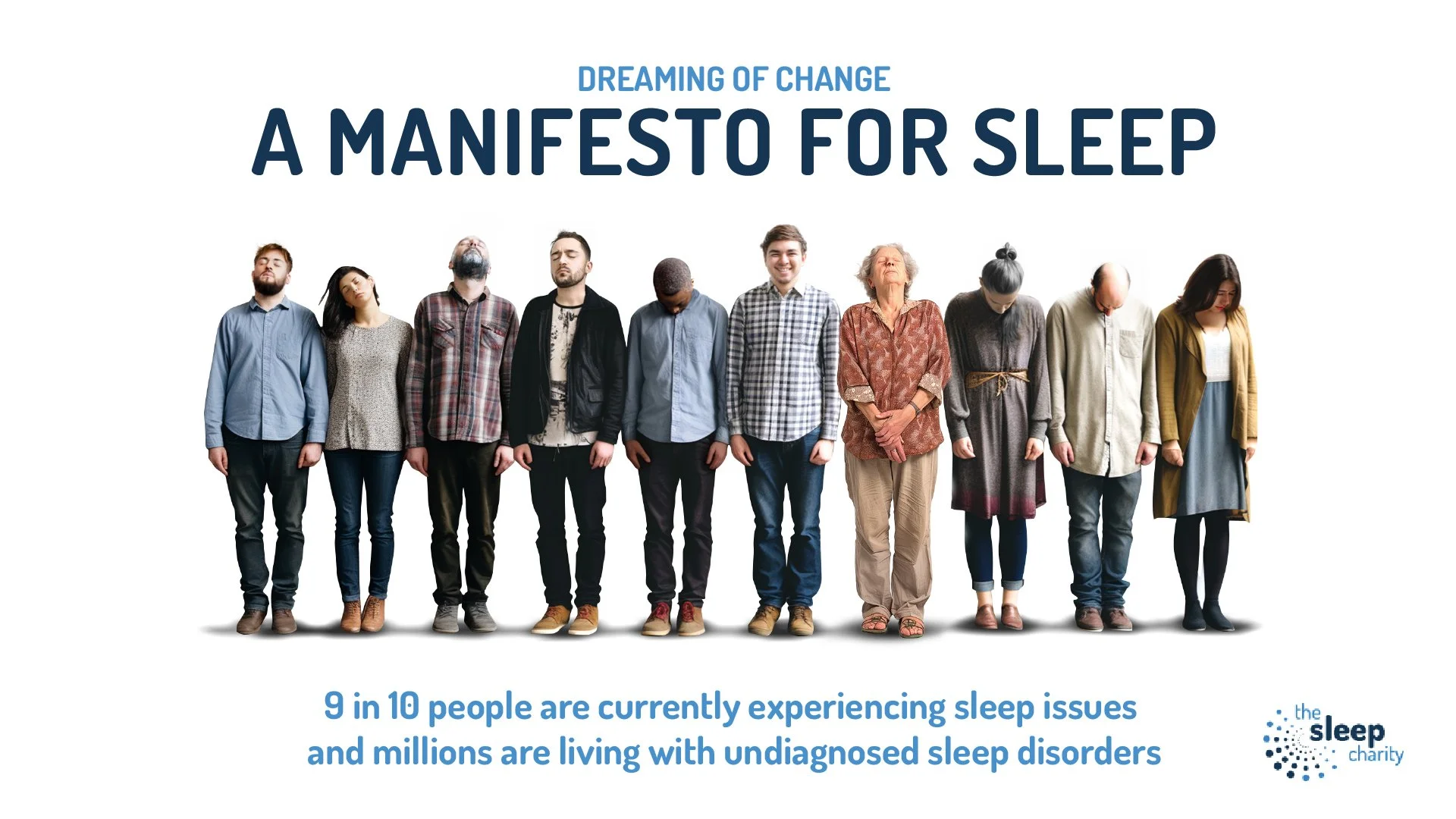
Our carefully crafted survey delivered compelling insights, highlighting that, because insomnia has been trivialised for so long, two in three people who experience it have never sought help, with those that do taking six years to reach out, on average.
This stark evidence helped frame insomnia not just as an individual challenge, but as a hidden public health crisis with enormous economic consequences.
Step 3: Unearthing powerful human voices through creative thinking
Numbers alone rarely drive genuine change - people do. However, we started the campaign with no ready-to-go case studies. This could have been a major barrier, but through creative, out-of-the-box thinking, we discovered and engaged with a private Facebook group for people who struggle with insomnia.
Our team carefully approached the group administrator, building trust and issuing sensitive, thoughtful callouts to members. This innovative approach unearthed powerful, heartfelt personal stories, vividly illustrating insomnia's profound impact. These narratives became the emotional cornerstone of our campaign, resonating deeply with parliamentarians, the media and the public.
Step 4: Creating an irresistible content package
Journalists receive countless pitches every day. To ensure ours stood out, we meticulously developed every element of our campaign package. Central to this was our flagship report, Dreaming of Change: A Manifesto for Sleep, clearly outlining the sleep crisis’s scale and practical policy solutions - from integrating sleep guidance into NHS campaigns to making NICE-approved face-to-face and digital treatments for insomnia and sleep apnoea available to everyone who needs them across England.
We complemented this with a tailored, compelling news release designed specifically for our targeted journalists. Additionally, we created a visually arresting campaign image illustrating that nine out of 10 people in the UK experience sleep issues. Every detail of our content package was strategically considered to ensure maximum impact and visibility.
Step 5: Engaging media and politicians in perfect harmony
On launch day, our meticulous planning paid off spectacularly. We secured 43 items of media coverage, including 12 minutes on BBC Breakfast, as well as feature length spots on ITV News, Five News and Five Live. National print and online outlets got behind the story too, with the Daily Mail, Mirror, Metro, Sun and ITV Online all running detailed articles.
Our campaign resonated with MPs too, with seven cross-party MPs demonstrating their support for the campaign.
On launch day, MP Nickie Aiken raised our manifesto in the House of Commons, triggering the Leader of the House, Penny Mordaunt, to commit to raising the issue with the Secretary of State for Health and Social Care. Andrea Leadsom, Parliamentary Under-Secretary for the Department of Health and Social Care, committed to sharing the report with her policy officials to consider how the Government could help.
The impact
Through strategic insight, creative storytelling, and relentless execution, we elevated a neglected issue directly onto the political agenda. Ministers not only recognised the seriousness of the campaign but pledged to review Government policy on sleep.
Winning Healthcare Campaign of the Year at the PRmoment Awards didn’t just highlight our campaign’s results - it confirmed the power of focused strategy, meaningful creativity, and dedication to transforming health through real outcomes.
At Evergreen PR, that's exactly how we like to make health happen.
About the author

Matt Thompson is Director of Evergreen PR, the healthcare PR agency that makes health happen. He has 20 years of experience in PR and communications and has led PR and media relations at several major household name brands. At Evergreen, he has worked with a wide array of high-level clients, leading the delivery of some of our most successful campaigns.
He is a strategic practitioner with significant expertise in campaign execution, particularly high-level media relations. He is especially experienced in media interviewing, having conducted hundreds of interviews and delivers regular media training for our clients.
Find out more about Evergreen PR: about us, our services, our work.