
What is healthcare PR? New industry definition shows where it adds most value

Photo by Patty Brito on Unsplash
A new definition of Public Relations (PR) has been published by industry body, the Public Relations and Communications Association (PRCA), following a member consultation.
Work on the long overdue new definition began after the PRCA’s CEO, Sarah Waddington, was involved in a ‘heated Radio 4 debate’ with Sir Martin Sorrell, an old guard of advertising, who appeared to have a fundamental misunderstanding of what the PR profession actually does.
The essence of the debate was that Martin Sorrell appeared to equate PR only with tactical media relations and was totally unaware of its strategic management role. He also appeared to hold the rather naive view that modern marketing is simply about “flooding the internet with content”.
The PRCA felt that if Sorrell, a notable marketer himself, doesn’t understand PR, then it is likely that many other business and marketing leaders might also be unaware of how our profession has evolved. This new definition aims to finally represent modern PR practice, underlining PR’s role as a strategic management discipline that helps organisations and individuals to build trust and create lifetime value.
Many of the elements in this new definition are particularly important when it comes to the health sector - and many stand out as areas of particular expertise for us at Evergreen PR.
The new definition
The PRCA has published two versions, a short standalone ‘core definition’ and a longer ‘extended definition’.
I think these are both excellent and I very much recognise in them the work that we do at Evergreen PR and the learning I undertook to become a Chartered PR Practitioner and to complete the CIPR Post Graduate Diploma, for which I got a distinction (sorry for the brag, I am just very proud of it!).
Core definition
Public relations is the strategic management discipline that builds trust, enhances reputation and helps leaders interpret complexity and manage volatility - delivering measurable outcomes including stakeholder confidence, long-term value creation and commercial growth.
Extended definition
Public relations (PR) is the strategic management discipline which enhances reputation, improves brand value, builds culture and enables organisations and individuals to achieve and maintain legitimacy with stakeholders and the public.
Grounded in ethical practice, public relations builds the trust on which organisational and personal performance and lifetime customer and shareholder value depend.
Through board advisory related to futures and foresights work, data and insights, stakeholder mapping and engagement, public affairs, risk preparedness, crisis management and more, the function's value lies in supporting leaders to reduce uncertainty, interpret complexity and manage volatility.
PR delivers credible two-way engagement that shapes perception, informs decision-making, supports behaviour change, builds commercial revenues and creates societal and economic impact. At its core, it works with organisations and individuals to create strong and healthy relationships with the people and groups affecting their ability to function, grow and succeed.
Applying the new definition to healthcare PR
Having worked almost solely in the field of healthcare PR, communications and public affairs for more than 20 years (that’s pre-social media folks!), my first thought upon reading the new definition was to see how it applies to healthcare PR and the work we do at Evergreen PR.
In my view, we can structure the definition into three areas.
Part 1 - helping health organisations to reduce uncertainty, interpret complexity and manage volatility
Healthcare is a very complex, uncertain and volatile space here in the UK.
While the 10 Year Plan aimed to provide a clear roadmap for the future of the NHS, the delivery of the plan is fraught with challenges in key areas including funding, structure, workforce, technology, integration, regulation and sentiment. Many of those challenges are also impacting consumer health, with people also having to navigate significant doses of misinformation and disinformation across multiple channels and platforms.
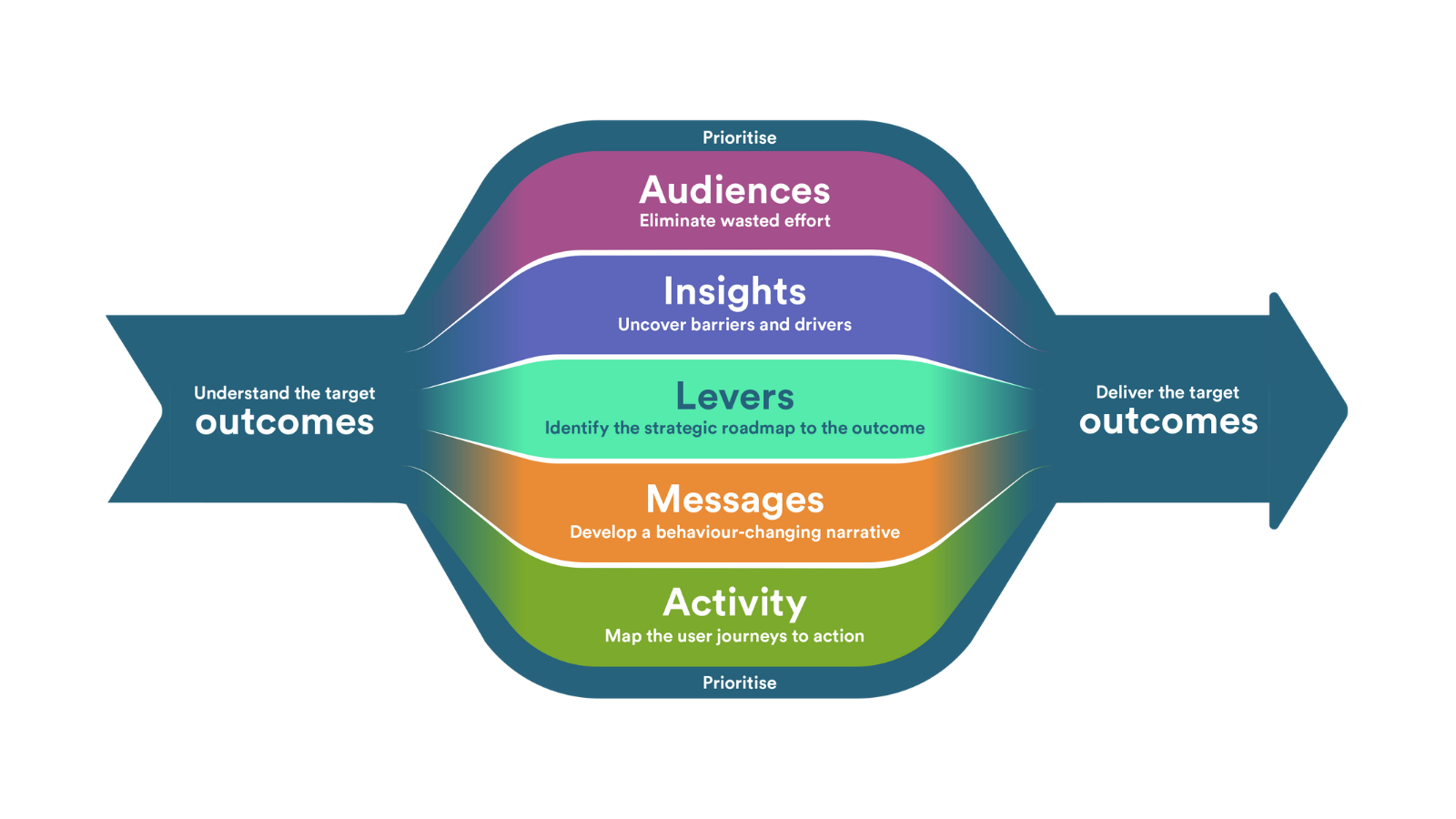
MERTO stands for ‘most effective route to outcomes’
It always amazes me that in this complex world, where the external landscape is constantly shifting due to ongoing interactions of diverse audiences, and where one misstep can cause a controversy, so many PR agencies are commissioned to work in a tactical silo, delivering PR campaigns (often digital PR campaigns) that in no way contribute to the voice and standing of the organisation they come from. I think it’s very risky. While you might get lucky occasionally, in the medium to long-term, this kind of approach has only two possible outcomes really (1) you get very little traction, as you don’t understand the landscape (2) you make a misstep, attracting criticism and undermining your attempts to position the organisation as a trusted expert to customers, investors, employees and other stakeholders. There really is such a thing as bad publicity - and, in the health sector, it can impact on the quality of care people receive and cost a health organisation millions of pounds!
At Evergreen PR, we ensure healthcare PR is grounded in insight and evidence and that it effectively balances the organisations’ target outcomes with the desires of its stakeholders and the realities of the complex external environment. We do this using the MERTO Map, our insight-led planning methodology, designed to help health organisations to identify the ‘most effective route to outcome’. By ensuring we have a deep understanding of our clients’ objectives, the stakeholder audiences whose perceptions and behaviour might need to change and the context that these entities exist within, we can provide the strategic campaigns and executive level PR counsel that health organisations need to be super successful.
This depth of understanding can be hugely important too when it comes to managing issues and crises. Over the last couple of months we have been helping a client to manage a complex communication challenge that was attracting media and political scrutiny. Our deep understanding of the organisation and its niche landscape has enabled us to minimise reputational damage and make progress towards its commercial goals, while, at all times, continuing to act ethically and in line with its societal purpose.
Part 2 - helping health organisations to create strong and healthy relationships with the wide variety of stakeholder audiences that affects its ability to function, grow and succeed
As the PRCA definition outlines: “At its core, [PR] works with organisations and individuals to create strong and healthy relationships with the people and groups affecting their ability to function, grow and succeed.”
Let’s look at some of the different kinds of organisations we work with and their priority stakeholders.
The NHS exists to provide high quality care to its patients and best value to tax payers. It is consistently held to account by patients, politicians, the media and the public.
Health technology businesses often sell products to the NHS, meaning they must be bought by commissioners and adopted by healthcare professionals and/or patients. They are consistently tracked by competitors and can be held to account by employees, the media, politicians, as well as their customers and users. Their visibility and credibility can directly impact their commercial success.
Health charities often serve patient communities and push for change in the NHS and by Government. Often, they are funded by a mix of public donations and local or national government contracts. They are often monitored by industry and scrutinised by Government and media. In order to change the landscape for their community, their ideas and initiatives must reach the people responsible for change and carry the evidence and credibility required for them to be adopted.
Private healthcare organisations often sell services directly to customers. They are often villainised by the media and politicians and must be very careful to follow industry regulations. They must demonstrate their honourable intentions and quality of care without being critical of the NHS.
In each case, these organisations must navigate a myriad of complex stakeholder audiences and diverse interests, in order to achieve their priority objectives.

Stakeholder Mapping and Prioritisation is crucial, and so is the human relationship element.
If PR is seen only as a content creation engine for securing media coverage, then there is a huge missed opportunity to utilise its broad relationship and positioning expertise, which is central to our training.
The startpoint here is to identify the relationships your organisation needs to strengthen and this can be done through Stakeholder Mapping, which is part of our MERTO Map process. This helps you to understand which relationships require the greatest focus and which are a time drain, but deliver little value to the organisation.
The PRCA definition champions PR’s ability to deliver credible two way engagement that shapes perception, informs decision-making and supports behaviour change. The key elements here are that the engagement must be credible and must be two way i.e. not one way broadcasting and not focused only on self-interest.
At Evergreen PR, we have developed a framework for mutually beneficial stakeholder engagement, called ‘Distinctive Value’. It is a simple one! The crux is that stakeholder relationships are usually based on a value exchange. By creating campaigns and content that provide the stakeholder with things that they perceive as valuable and that they couldn’t easily get from elsewhere, a health organisation can serve the interests of that stakeholder, and, in return, receive support for its initiatives.
An example of that in action came recently for us, when supporting our health tech client to attract interest in their AI technology by launching a new free non-commercial educational platform to support NHS Trusts to better understand how to roll it out at-scale. The platform has become central to their narrative, attracting interest, sign-ups and leads.
As an agency that specialises in ‘breakthrough health campaigns’, we love designing activity that engages multiple stakeholder audiences at the same time, triggering a cascade of actions that together deliver the target outcome. We are currently working on a very exciting global campaign for a medical device business that has a myriad of stakeholders, including patient communities, a healthcare professional community, patient charities, a leading specialist patient publication in the US, a US university and social media patient communities. Our purpose-led campaign has enabled our commercial client to attract seven partner organisations, spread across both sides of the Atlantic, and, we believe, will lead to a change in the landscape for patients, which is hugely motivating. This kind of campaign demonstrates the expertise of our client and does social good, it builds awareness and trust, enhances reputation, builds brand value, increases employee pride and, we believe, will ultimately drive commercial revenue.
Part 3 - proving measurable outcomes, including commercial growth, enhanced reputation among stakeholders and changes in behaviour
One of the best things about the new PRCA definition is that it takes the bull by the horns on measurement. When I set up Evergreen PR, our founding principle was that we would never design a campaign to only generate awareness. I always hated it when I read a boastful case study on a PR agency website and in the results section they could only share the reach figures for press coverage or social media posts - that isn’t an outcome and it isn’t strategic. Right from the beginning, we have always looked to influence and measure changes in reputation and behaviour.
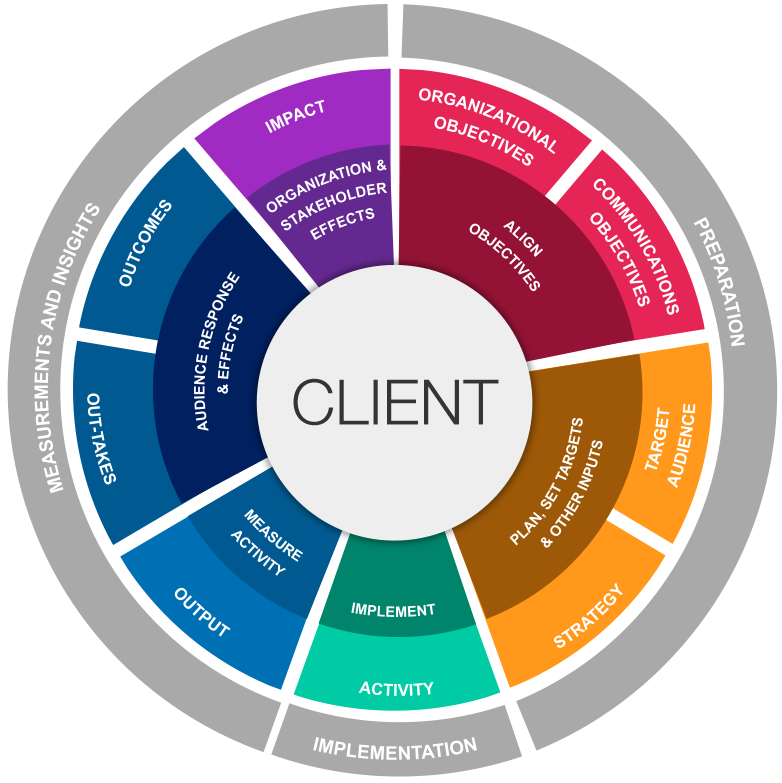
AMEC’s Integrated Evaluation Framework informs best practice PR and communications measurement.
The new definition outlines a multitude of measurable ways that PR can deliver tangible value, including enhancing reputation, improving brand value, building culture, supporting behaviour change, building commercial revenue and creating social and economic impact.
My hope is that it drives a step change in focus. Previous analysis done by me for the CIPR revealed that only 1 in 3 national PR award entry campaigns list an outcome as a result of their work. Given that these were campaigns entered into national awards, it is likely to be even lower across the industry as a whole. But that can change!
The key thing with measurement though is that you have to be intentional, designing it in from the beginning, not bolting it on at the end as an afterthought.
We’ve previously published a ‘practical guide to evaluating business and health outcomes from healthcare PR’, which goes into more detail on this topic but, in essence, best practice principles from AMEC (the International Association for the Measurement and Evaluation of Communication) propose that PR professionals should be measuring their work at four levels:
Outputs (what was produced) - measured in terms of volume and reach
Outtakes (what was the response) - measured by feedback and changes in perception
Outcomes (what actions were taken) - measured by actions, including changes in behaviour
Impact (what value was delivered) - measured in terms of organisational performance, improvements in relationships, changes to the external environment
Most health organisations will measure outputs such as volume and reach of activity such as press coverage, social media content, newsletter output etc. Many will also measure engagement with the content they produce and anecdotally reference feedback received.
I suspect that few have a robust stakeholder reputation measurement programme in place and that even fewer are able to draw a line from the PR and marketing activity they deliver to the leads they generate. Both of these are possible and both, ultimately, lead to better quality campaigns and higher ROIs.
If you would like to learn more about the wide variety of ways in which a strategic healthcare PR agency, like Evergreen PR, can help you to achieve your business objectives and prove its contribution, get in touch with us via our contact page.

Leigh Greenwood is the founder and managing director of Evergreen PR, the healthcare PR agency that makes health happen. He is a chartered PR professional who has been working in healthcare PR, public affairs and communications for the last 20 years. He has worked across the whole spectrum of healthcare and has won more than 40 industry awards for effective health campaigns that generated measurable outcomes.
Find out more about Evergreen PR: about us, our services, our work.