
AI is reshaping news: are you giving health journalists the stories they need?

It is safe to say that AI is having a transformative impact on the news media landscape, presenting significant challenges, but also opportunities for health organisations seeking to generate media coverage.
One clear risk is that AI’s ability to generate content rapidly and at-scale is leading to publications being inundated with huge volumes of generic, AI-written pitches, making it even more difficult to win the attention of journalists. At its worst, this has enabled unscrupulous PR or SEO agencies to circulate fake stories using fabricated experts - a topic we have explored recently in our PR Hall of Shame blog.
Fighting back in the battle against generic AI-generated ‘slop’, publishers are beginning to place greater emphasis on ‘distinctive content’.
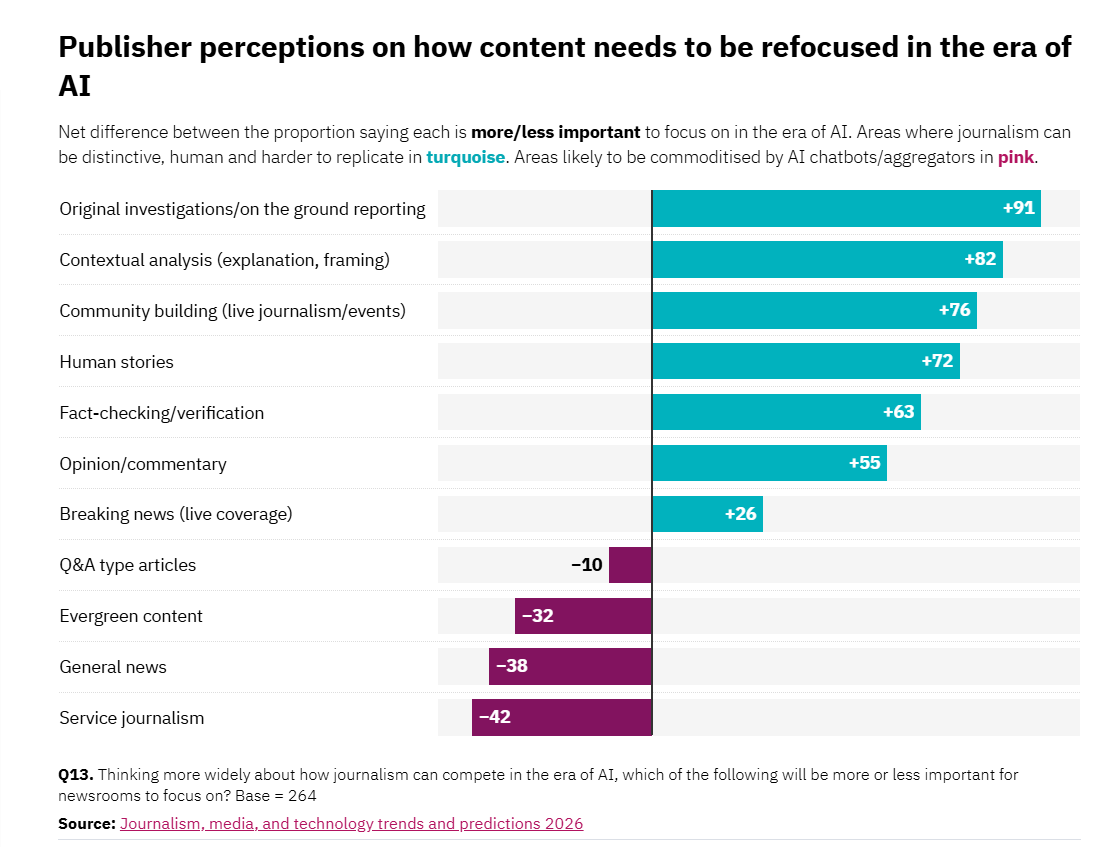
According to a recent report by the Reuters Institute for the Study of Journalism at the University of Oxford, global news publishing leaders plan to compete with AI-generated news by moving away from generalised coverage and towards more original journalism. This includes on-the-ground reporting, in-depth analysis, human stories, and opinion.
This shift has also been echoed by insights from frontline journalists. Rosie Taylor, an award-winning health journalist who writes for The Times, Telegraph, The Guardian and Daily Mail, among others, has spoken about the growing demand from health editors for exclusive, high-quality news packages that combine robust data with real human stories and credible expert voices.
For switched-on health organisations able to offer this kind of distinctive content, the rewards are clear. Campaigns are more likely to stand out to journalists and will generate higher-quality media coverage that also stands out to the end consumer.
But how can health organisations create distinctive content?
The power of distinctive data
One way to create distinctive stories is to use, or, better yet, generate, distinctive data. Distinctive data can be generated in many ways, including through surveys, pilot studies, academic research, and Freedom of Information (FOI) requests.
Data-led stories are very popular with journalists, and if of a high enough quality, can allow you to advance evidence-based arguments, offer unique analysis, and demonstrate the scale of an issue by quantifying its impact.
Evergreen regularly builds data-led campaigns that cut through with the media and stakeholders.
For our ‘Taking Veteran Healthcare Mainstream’ campaign for the Royal College of GPs and the UK Government's Office for Veterans’ Affairs (OVA) we surveyed 5,000 veterans to explore how service in the Armed Forces had impacted their physical and mental health.
We found a startling truth, that many veterans struggle with their health but don’t visit a GP for fear of not being understood by a civilian healthcare professional. We built a range of media and stakeholder packages to announce the finding, ultimately driving 10% of all GP practices in England to sign-up to become ‘Veteran Friendly Accredited' practices.
Showing the human side
Data can show scale, but real people can show impact. Regular people who can share their lived experience will bring colour to a story and make an issue ‘real’.
Healthcare or academic experts can also be used to build on a data-led story by offering commentary and or an opinion on the topic of your story.
We combined the authenticity of lived experience with the authority of experts to show the devastating, but often overlooked, impact of sleep problems in our ‘Dreaming of Change’ campaign for the Sleep Charity.
While the campaign cut through with new data that revealed the scale of sleep problems in the UK, the message that sleep issues could not be ignored was driven home by patient spokespeople and academics. These spokespeople appeared on BBC Breakfast and Channel 5 to share their experiences of insomnia and what change was needed to improve support for people with sleep problems.
Along with securing extensive broadcast coverage and articles in the Daily Mail, The Sun and flagship medical publication, The Lancet, the campaign led to two Health Ministers raising the Sleep Charity’s calls for change with the Secretary of State for Health and Social Care.
Offering compelling news packages
It’s not enough to create distinctive content, you have to put it in front of the right people in the right format. Only then will you turn potential into results.
For broadcast media, this means developing a clear broadcast package that leads on your story, what spokespeople are available for interviews and what locations can be made available for filming. Our Director, Matt Thompson, has more advice on how to build breakthrough broadcast packages in another expert blog.
Many healthcare trade media titles offer viewpoint article opportunities, allowing you to maximise your chances of coverage by offering a relevant healthcare professional to provide an opinion article alongside your news story.
Thinking about the onward journey
You’ve created distinctive content for journalists, but what do you want a reader to do after they’ve read or watched your story?
The most effective campaigns will have a clear onward journey mapped out to turn attention into action.
This could involve signposting readers to your website, or motivating themh to engage more deeply with an owned resource or event, such as a webinar, that can then be used to nudge visitors further towards taking your desired actions.
Of course, any link needs to also offer distinctive value to readers in order to make the editor’s cut. For a commercial business, it will be particularly important to ensure that any linked page or resource is not overtly commercial, is of genuine interest to a reader, and is framed around an issue that you can credibly claim to be addressing.
For a not-for-profit, the onward journey must also offer unique value, which could come in the form of an educational resource, a downloadable guide, policy briefing, or a clear route to service access - depending of course on the objective of the campaign, the audience you are targeting and what action you want them to take.
Conclusion
In an age of unlimited content generation ushered in by AI, news brands are looking for distinctive stories that AI can’t provide, such as original reporting, analysis, opinion and human stories.
Healthcare organisations can use data and spokespeople to craft this kind of distinctive content. Those that invest in doing so, stand in a much better chance at cutting through with the media and driving results for their organisation.

Chris Hayter is an Account Manager at Evergreen PR, the healthcare PR agency that makes health happen.
Chris has extensive experience of driving forward programmes of activity that generate meaningful impact for charities, royal colleges, health professional bodies, and med-tech and health-tech clients.
Find out more about Evergreen PR: about us, our services, our work.