
New guidance: How strategic healthcare communications can help SMEs sell to the NHS

“Working with the NHS is a complex, ever-evolving journey that requires patience, persistence and a smart strategy.”
That’s the upfront message from NHS England’s ‘SME Advisory Group’, in its newly published guide: ‘How SMEs can work effectively with the NHS’.
In case you’re not familiar with it, the SME Advisory Group is an initiative that brings together UK SMEs, NHS England and other system partners with the goal of creating a positive ecosystem that leads to better care for patients and better value for taxpayers. Our client, Big Health, creators of Sleepio, the evidence-based digital CBTi treatment for insomnia, is a member.
SMEs are very important to the NHS. In fact, 85% of its 80,000 suppliers are SMEs. This figure alone demonstrates the appetite the NHS has for engaging with SMEs.
Recently, the SME Advisory Group held a series of workshops to discuss what SMEs should focus on, if they want to trade with the NHS. TL;DR, while there are also other factors at play (such as compliance and funding), the SME Advisory Group guide makes clear that audience insight, narrative positioning, prioritisation and relationship building are all vital to success. These are all elements that a strategic healthcare PR agency could help you with.
Priority 1 - identify who is part of your prospective NHS buying panel
The guide starts by emphasising the importance of SMEs having a deep understanding of their target customer.

It’s important to note that while ‘customer’ sounds like a singular term, in reality, a whole panel of people are typically involved in any NHS decision to purchase a product or service from an SME. For example, for a health tech product, that buying panel could include clinical, operational, digital, governance and procurement teams and so, while many SMEs get fixated on their primary user e.g. a hospital nurse, the reality is that they often need to think much more broadly. The guide states that you ultimately need to understand who has influence, who controls the budget and who needs to be convinced.
At Evergreen PR, we use our MERTO Map planning methodology to identify and prioritise audiences. As an outcomes-focused healthcare communications agency, our team is of the strong belief that outcomes only happen when we persuade specific audiences to take specific actions. We know that the first step to this is understanding who those audiences are.
Stakeholder Mapping can help you with this. Start by listing everyone who is involved in the buying decision. Maybe you know this or maybe you just think you know. At the very least you should test and validate any assumptions. Some methods could include: ask any existing customers who else was involved in their decision; use Google and/or Google Scholar to identify any reports, blogs or studies that can add depth to your understanding; ask your preferred AI tool for its view and then dig into the evidence that it provides for its claims; speak to a market access consultant; speak to employees from the kinds of organisations that you aim to work with. The more sources your conclusions are based upon, the more likely they are to be accurate.
Many organisations skip this step altogether, or spend a cursory hour on it before getting to the more exciting part of thinking about messages or narratives. We understand why. You are busy. You think you already know. However, in our view, that’s a big mistake as, if you don’t truly understand all of the people involved in the decision, then you can’t possibly address the collective barriers to purchase.
Of course, not everyone involved in the decision will have equal input. So the next step is to prioritise those stakeholders. We use a simple scoring method based on their level of ‘power and interest’. This helps us to understand where to focus the majority of our effort and messaging, while still being sure to address the key concerns of those stakeholders that don’t directly make the decision, but who could influence it.
Priority 2 - be crystal clear about the value you’re offering to your NHS audience
The importance of a clear value proposition is absolutely paramount. As the guide says, the NHS is a complex organisation with competing priorities, so “to stand out, you must solve a specific, measurable problem.”
I really like this section of the guide, because it is absolutely right. An effective value proposition must articulate the pain point, bring to life the solution and show what outcomes can be proved. One of the biggest mistakes health tech SMEs make when selling to the NHS is assuming that their list of features is what will secure interest when, in reality, it is their ability to tell the story of the problems their product solves. Compelling messaging is at the very heart of our MERTO Map planning tool, and we ensure effectiveness by incorporating behaviour science principles and wrapping these up in a persuasive ‘narrative flow’ that covers problem, solution, evidence and action. For a closer look at the secrets of behaviour change messaging, check out our expert guide.
The guide advises spending time researching the wealth of information that is available on your NHS customers, so you can understand what problems need to be solved. Once again, this is a step that too many people skip, relying on personal experience or assumed knowledge. However, the quality of the research done here is, without a shadow of a doubt, the most important factor in being able to uncover the kind of amazing hero messaging that will open doors and convert interest.
There are so many reports and published papers looking at the issue of barriers to NHS adoption. Look for those based on products that are similar to yours and/or buyers that most closely mirror your priority stakeholders. Again, I would advise using Google, Google Scholar, AI tools like Perplexity, thought leader articles from known experts in the field and see if you can arrange structured interviews with representatives of your target audience. A breadth of sources will provide the strongest foundations.
At Evergreen PR, we often start our work with a PESTLE Analysis, allowing us to capture key political, economic, social, technological, legal and environmental evidence to inform barriers and drivers for our target audience. We’ll consider the COM-B behaviour change framework too, which states that for a behaviour change, a person must have the capability, opportunity and motivation to take that step. Not to oversimplify, but the essence of this means that if we can inspire people to want to change or feel that they should change, and give them the education and straightforward user journey to make it easy for them to change, then we are a long way down the track.
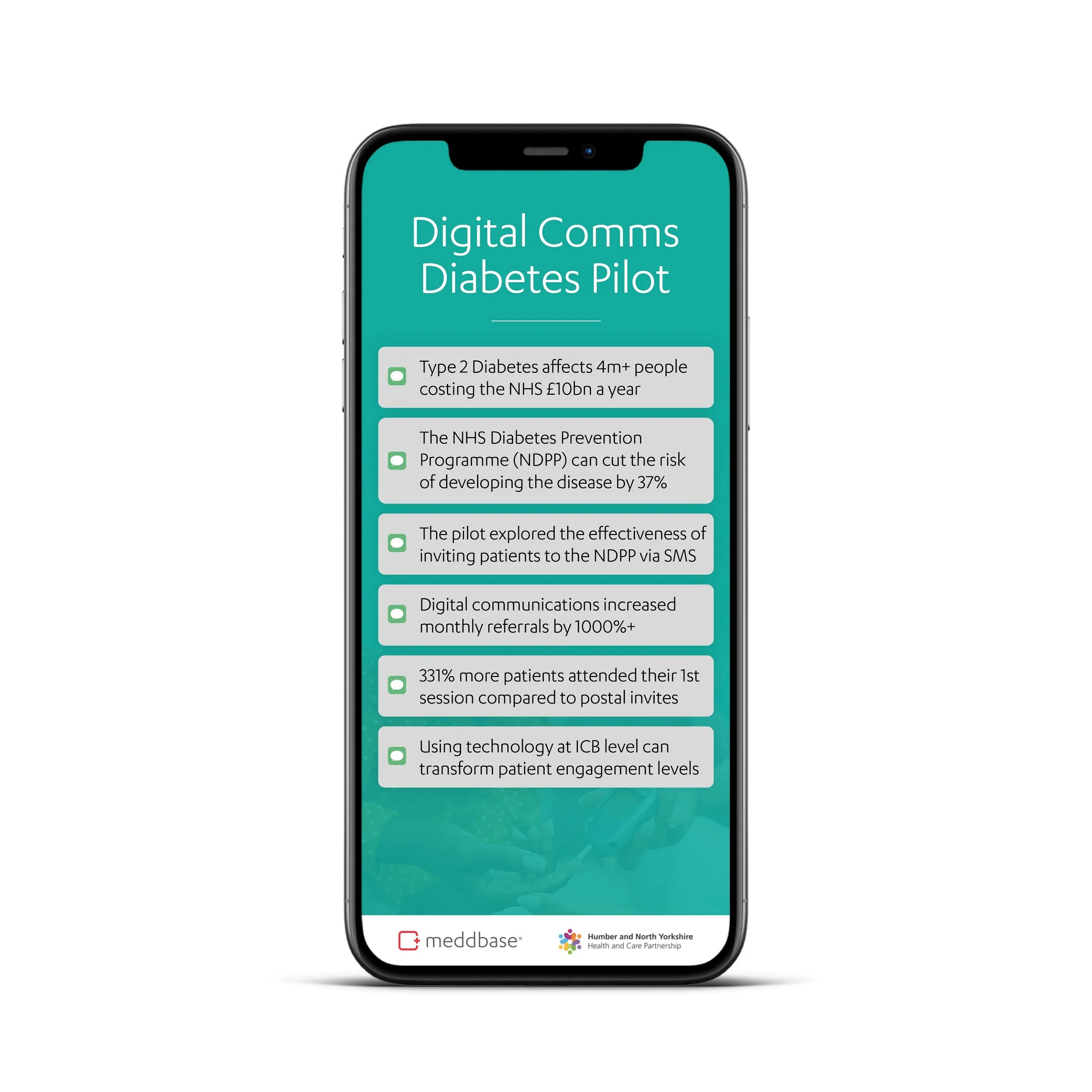
An example of all of this can be seen in our work for UK SME, Meddbase, where we helped the medical technology business to secure its first NHS customer. A pilot study had identified that its software had successfully increased uptake of the NHS Diabetes Prevention Programme (DPP). We built a narrative around that data, based around the key argument that, while the NHS DPP is proven to be effective, it can only help people when they activate their referral. This allowed us to position Meddbase’s software as a gateway to the NHS DPP fulfilling its potential. We also provided an educational report and webinar so that other ICBs could learn how to implement this. It was a big success, with our report generating 16 articles, 1,300 visits to a new landing page in one month and in-bound enquiries from five of the 42 NHS Integrated Care Boards in England. A major sale was achieved within three months.
Priority 3 - build relationships and network effectively with NHS prospects
As the guide states, ‘the NHS runs on relationships’, and so building them with the right people is paramount.
Relationship building is at the heart of Public Relations (PR) and so, while it should be the SME that establishes and maintains these relationships, a good healthcare PR agency can equip you with the tools and principles to do this effectively.
There are all sorts of models and frameworks that inform and measure relationship building. Most agree that trust is central and studies show that this is based on perceived competence, integrity and benevolence. A similar number identify the importance of value creation or exchange i.e. a person will only invest time in a relationship if they feel they are getting something worthwhile in return.
At Evergreen, we have developed the concept of ‘distinctive value’ as a method for establishing and nurturing high value relationships. By creating narratives, materials and interactions that are: valuable to the recipient, non-commercial in nature; couldn’t easily be sourced from elsewhere; demonstrate expertise; based on evidence and aligned with your organisation’s societal purpose, SMEs can engage individuals and organisations more deeply.
Deeper relationships, built on trust in expertise and of ethics, are, ultimately, more likely to create value for both parties. From an SME perspective, that makes it more likely that you can sell your product to the right customers and, ultimately, improve the health of more people.
If you are a healthcare-focused SME that would like to learn more about how strategic healthcare PR can help you to establish the positioning, profile and credibility you need to increase sales to the NHS, get in touch via our contact page.

Leigh Greenwood is the founder and managing director of Evergreen PR, the healthcare PR agency that makes health happen. He is a chartered PR professional who has been working in healthcare PR, public affairs and communications for the last 20 years. He has worked across the whole spectrum of healthcare and has won more than 40 industry awards for effective health campaigns that generated measurable outcomes.
Find out more about Evergreen PR: about us, our services, our work.