
Healthcare PR secrets: how to engage with healthcare professional media
As a healthcare PR agency that specialises in breakthrough campaigns that make health happen, we’re frequently asked by clients and prospects how they can cut through the noise and reach healthcare professionals with their messages.
In many cases, they have already tried several approaches but have found that, in the current context of healthcare systems and staff working under extreme pressure, their attempts to engage health professionals just haven’t landed.

There are around 200 healthcare professional-facing media titles in the UK and a further 200+ healthcare business titles. Many of these media outlets are built around specific professions or topics. For example, there is GP Online, Pulse and the British Journal of General Practitioners that target GPs and there are all manner of health tech related titles, such as Digital Health, Health Tech News and Health Tech World, catering to health professionals and commissioners with an interest in tech.
Each title has a slightly different focus and, therefore, requires a slightly different approach to maximise impact, but these outlets undoubtedly represent a great opportunity for organisations that wish to reach healthcare professionals with their messages.
What are you trying to achieve?
If you believe healthcare PR is just a way to ‘increase awareness’ of your organisation among health professionals then we believe you are significantly underestimating the potential impact of a well-planned breakthrough health campaign.
You really should be starting with your priority business outcome in mind.
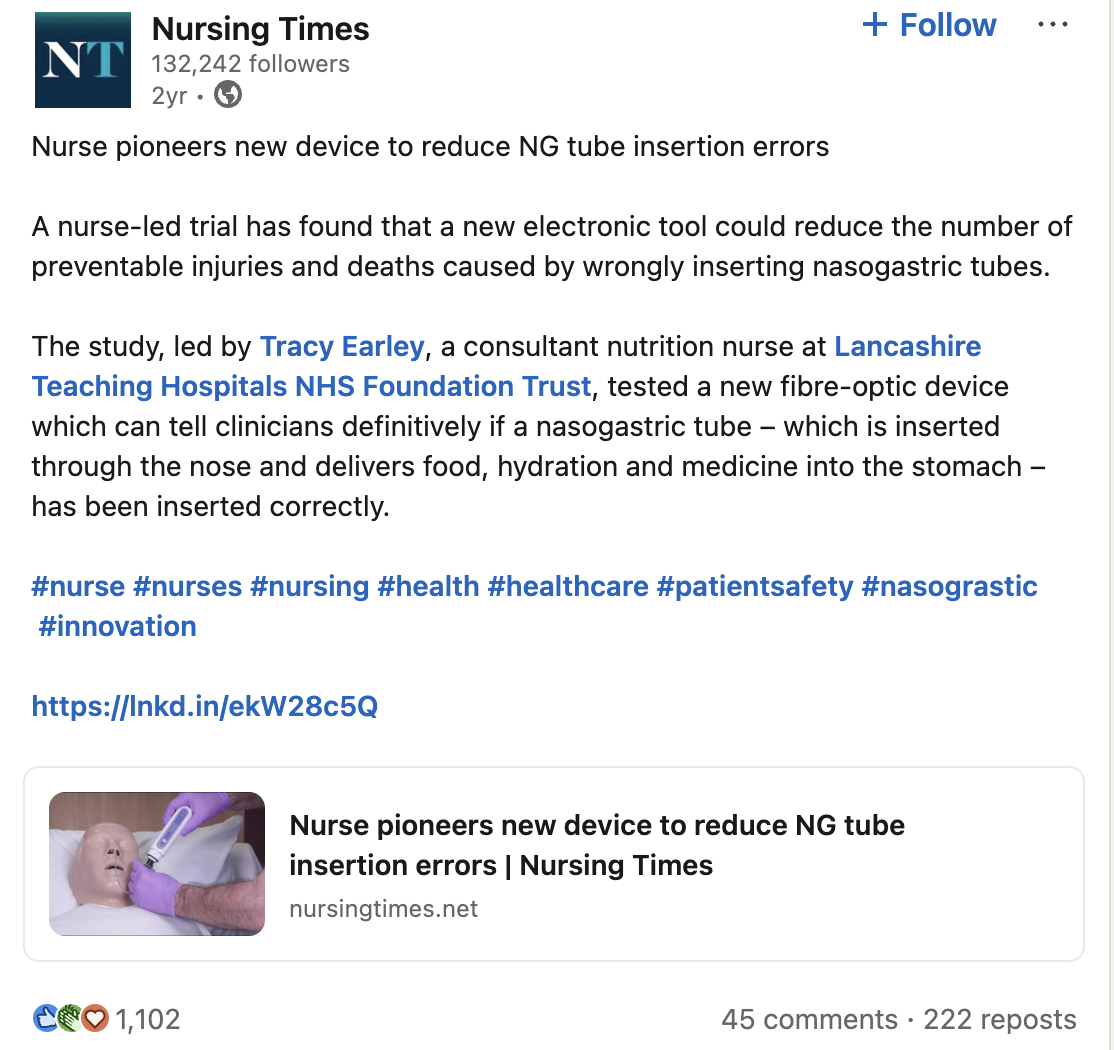
An article we placed in Nursing Times for our client, NGPod, attracted 1,000+ engagements, plus 200+ shares when the title shared it on LinkedIn
Which health professions do you need to convert?
A clear understanding of the different individuals involved in the decision/behaviour you want to influence is the first step to knowing which media outlets to target and what messages to serve.
It’s important to get the balance right between being too narrow and too broad. For example, we often work with companies who need to influence GP practices and default to only targeting GPs - when in fact they now represent just 26% of the practice workforce - and there are plenty of outlets that target other primary care staff. Equally, we often receive fairly messy briefs that list scores of different healthcare professions when, in fact, most of the influence might sit with just one or two. A good healthcare PR agency will take the time to surface the insight and prioritise accordingly as it is only by understanding your audiences that we can select the optimum media targets.
What about your journalist audiences?
Every media outlet is different in some way, with different perspectives, audiences and opportunities available and, within those outlets, there are often several journalists, who may also have different preferences and ways of working.
If you are serious about engaging health professionals through the media then you must take the time to research your target outlets and the journalists who write for them. By researching them, I mean genuinely consuming their work with the goal of understanding their interests and how their stories are configured - not quickly adding them to a long list of people to bash a press release out to. A specialist healthcare PR agency, like Evergreen PR, will already have good base knowledge and, in many cases, good relationships in place, but every campaign is different and media audits should be done on a campaign basis for maximum effectiveness.
It is worth remembering that relationships can only get you so far and, more than anything, you will need to ensure you have the right campaign story and package to pique the interest of key journalists and important media outlets.
What’s a good story?
You don’t just rock up to a media outlet with your messages and expect them to publish them. The currency that journalists work in is based on stories. Stories are things that are interesting that other people will genuinely want to know about.
A good story has several components - it should be hard to ignore (i.e. it is interesting, consequential), hard to deny (i.e. there is evidence that any claims you are making a true and can be trusted) and there is a potential solution available (i.e. a product, a policy, an initiative). Most importantly, a good story should provide value for the outlet's readers or listeners, otherwise, why on earth would they publish it?
It’s worth remembering that the literal meaning of ‘news’ is ‘what’s new’ and so if you want to be featured in the news, you need to do, prove or uncover something new. There are so many rich topics in healthcare and shining a light on an issue or challenge, highlighting who is impacted and how and demonstrating how this challenge can be addressed can provide a good narrative basis.
You can tell when a story has delivered value to the readers by the impact it has. For example, our story about NGPod’s medical device, which was developed by a nurse and improves patient safety by reducing ‘never events’, was covered by Nursing Times and the resulting LinkedIn post attracted 1,100 engagements and 223 reposts - that’s a clear demonstration that the content added value to the target audience. It also generated leads for the business.
In some cases you might have a health tech product, medical device or software that helps solve the problem you have identified, in others you may have ideas and recommendations for how things must change. You’ll need to draw on evidence for your argument and you’ll need to be careful that your message is not overtly commercial. This is not always easy but it is usually possible.
Packaging for your audience
Every journalist who you pitch to should get the feeling that they have been handpicked to receive this package - as it is just perfect for them. It’s about something that interests their readers/listeners (and them), it’s served in exactly the right format with the right kind of imagery or collateral and there are potentially opportunities to go deeper if they wish.
Naturally, healthcare professional focused media outlets want to reflect the views of their readers. The readers of Nursing Times are different to the readers of GP Online, and different again to readers of Dentistry. Therefore, the news package that you build should be different for each title. Having a healthcare professional spokesperson for each relevant profession can be helpful. Including their comment in any news release can improve cut-through, while they might also author viewpoint articles, providing a relatable healthcare professional perspective that will be trusted by the readers/listeners.
Proof
Over the last few years, following this approach, we have helped:
A medical software company to move from a standing start to selling their product to NHS Integrated Care Boards
A royal college to generate an 800% increase in GP practice sign-ups to a voluntary programmes
A medical device business to drive inbound enquiries from hospitals and secondary care nurses
In each case, we developed an issues-led ‘breakthrough health campaign’ that cut through the noise with the target audience (who were different in each case), built the authority and expert status of our client and drove those audiences along a user journey that, ultimately, led to them changing their behaviour in the way needed to deliver the goal.

Leigh Greenwood is the founder and managing director of Evergreen PR, the healthcare PR agency that makes health happen. He is a chartered PR professional who has been working in healthcare PR, public affairs and communications for the last 20 years. He has worked across the whole spectrum of healthcare and has won more than 40 industry awards for effective health campaigns that generated measurable outcomes.
Find out more about Evergreen PR: about us, our services, our work.